Ebook Download The Theology of the Book of Revelation (New Testament Theology)
One of inspiring factors that you could preferred to get this book is due to the fact that this is extremely appropriate to the condition that you encounter currently. The condition is not only for you that are not scared to obtain brand-new thing, for you that always feel that you require brand-new sources to make far better life. And this publication is very proper to review even in only short leisure time. Yeah, with the soft data of The Theology Of The Book Of Revelation (New Testament Theology), you could take very easy to continuously check out and also read this publication again.
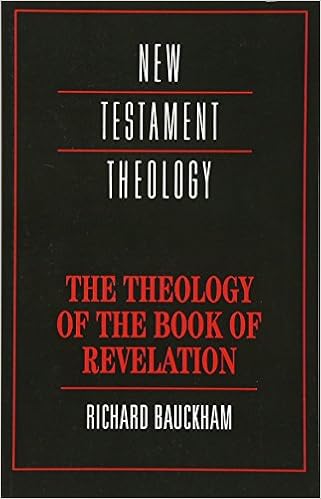
The Theology of the Book of Revelation (New Testament Theology)

Ebook Download The Theology of the Book of Revelation (New Testament Theology)
Check out this very attractiving book. From the title, from the selection of cover layout, and from the bold author to display, this is it the The Theology Of The Book Of Revelation (New Testament Theology) Still have no ideas with this publication? Are you truly a good viewers? Discover great deals collections of the book written by this very same author. You could see how the author actually presents the job. Now, this publication comes up in the publishing world to be among the current publications to release.
This factor is among some factors that make lots of people primarily wish to read this publication. It is likewise suggested with the better of how the writer shows the explanation, providing instances, and also chooses the dictions. Every word as well as sentence that is added to load as a publication entitled The Theology Of The Book Of Revelation (New Testament Theology) appears in very enhancing problem. This is not only for the reading product but also a god selection for reading.
Related to this scenario, you can actually have the moment to take The Theology Of The Book Of Revelation (New Testament Theology) as so as possible. Be just one of the fantastic people that take this publication likewise for resource. For ensuring you to obtain this book, we will demonstrate how you could find and also get the soft data of it right here. Just adhere to the link that we provide and also you can directly find and also make bargain to obtain this publication. This is only selected to obtain and also save it in some gadget that you bring everywhere or at home or office.
Currently, this disliked publication is cooperated the link. You should go seeing the link and get the book. By saving this The Theology Of The Book Of Revelation (New Testament Theology) in the soft documents forms, you could divide it or include it right into some type of devices. Computer, gizmo, or laptop computer can be choice to conserve this publication application. So now, when you have already the system of on the internet book, it's better to stimulate this publication to check out.
Product details
Series: New Testament Theology
Paperback: 184 pages
Publisher: Cambridge University Press; unknown edition (March 26, 1993)
Language: English
ISBN-10: 9780521356916
ISBN-13: 978-0521356916
ASIN: 0521356911
Product Dimensions:
5.5 x 0.5 x 8.5 inches
Shipping Weight: 7.2 ounces (View shipping rates and policies)
Average Customer Review:
4.6 out of 5 stars
71 customer reviews
Amazon Best Sellers Rank:
#57,982 in Books (See Top 100 in Books)
At first I didn't use this right. I was trying to read Revelation and understand it, but Bauckham's Theology of the Book of Revelation is not a verse-by-verse guide. However, after I read the book with a verse-by-verse guide (thank you, William Barclay) Bauckham's book was very instructive for putting meaning into the book as a whole, with themes and concepts.
This is one of the best books on Revelation I have read. It is concise and to the point and makes sense of the most misunderstood book of the Bible from both an historical and a theological viewpoint. Unlike the majority of books written about Revelation, it doesn't go verse by verse but covers the major themes independently which gives the reader a much better overall perpective.Bauckham demonstrates how it is a mistake to interpret Revelation from a purely historicial perspective (ie Preterist) which makes it relevant only to first century Christians. It is also a mistake to read it from a purely futuristic perspective (ie Dispensationalism) which doesn't make it relevant for the people to whom it was originally addressed. This also leads to false assumptions, some of which turn out to be false, and makes it even more confusing.Bauckham believes that the symbolic creatures in Revelation can only be identified with specific first century entities which the original readers had to cope with. He is consistent with most scholars in identifying the Dragon with Satan, the Seprpent, which was the primordial source of chaos and evil in the universe. The Beast from the sea is the first century Roman Empire, and the beast from the land is the Roman imperial cult which propped up the deity of the emperor. These three represent an anti-trinity. The harlot is identified as the city of Rome and the 144,000 represent an army of faithful Israelites who act in the role of holy warriors in participating in the sacrificial martyrdom of the Lamb.Revelation as a prophetic book canonized as scripture has a timeless relevance just as Jesus and the apostles used earlier prophetic books to explain the times they were living in. It's underlying message is just as relevant for Christians living today as it was at the time it was written.Bauckham demonstrates how Revelation is thoroughly Jewish-Christian. It borrows heavily from the Hebrew scriptures and makes parallel reference to Ezekiel, Daniel, and the Exodus story. The use of Temple symbols also makes it highly unlikely that it was written by a gentile for a gentile audience.Revelation shows a very high Christology, similar to Paul's letters, and is strongly trinitarian. Jesus is clearly the risen Lord enthroned in Heaven who will return in triumph. This blows apart the theories of modern liberal scholars who want to portray Jesus as a wandering itinerant revolutionary sage who was exalted by gentile churches centuries later. Revelation makes it very clear that the exaltation of Jesus began at a very early date within the Jewish Christian community.Bauckham points out that Revelation is not for modern feel-good charismatic Christians. John calls the churches to be faithful witnesses to God's Kingdom even to the point of participating in Christ's sacrificial death through martyrdom. In the first century Roman Empire, declaring Jesus as your Lord had dire consequences.Bauckham makes it clear that people who try to interpret Revelation from a purely futuristic perspective by trying to identify its symbols with present or future entities miss the whole point. Revelation's timeless message is that God's Kingdom, although hidden, remains in opposition to the idolatry of man-made kingdoms which are based upon power and exploitation. It challenges the status quo.The hope which Revelation offers is that no matter how bad or corrupt the world becomes, God is still on the throne and will prevail in the end.
While I don’t agree with everything Baukham writes, this is an elegant and beautiful explication of the theology of Revelation. Highly recommended. He doesn’t spend much time discussing the dating of Revelation. For that I would recommend Kenneth Gentry’s Before Jerusalem Fell.
Reading this book turned Revelation from one of my least favorite to favorite books of the Bible. For people living at the seat of global economic and military power, a thorough understanding of John's critique of Rome might be just what the doctor ordered. Bauckham helps you understand those criticisms in a relatively short span of pages.
This book highlights the theology of the book of Revelation, as opposed to focusing solely on eschatology. As such it is a breath of fresh air. Keen insights into the nature of and relationship between Father and Son. Ultimately, there is of course some treatment of eschatological issues. The book provides a mature interpretation of the dragon, beast, and false prophet that deepened my understanding, even though I ultimately disagree with the authors conclusions regarding the return of Christ and the Millennium.
I find it a little odd that those who rated this book as being poor found it fair to do so primarily on the basis on its supposed difficulty. To give a book a poor rating for its difficulty is like complaining that the view from the top of a mountain is diminished because of the effort required to get there. (It is also, I think, a bit like blaming someone else for one's own stupidity). Anyway, that said, one thing that struck me about this book is just how smoothly it reads. It is truly a pleasure to be able to sit at the feet of a scholar who has clearly spent years grappling with the content of what is probably the most perplexing book in the New Testament. This book irons away all those hermeneutic wrinkles and contradictions that arise from trying to make sense of Revelation in isolation from the world in which it was written.As other have already noted, the real strength of this book is that it is an attempt to do justice to the actual historical context within which Revelation was composed. It does the reader the favor of making explicit what it means to read Revelation, not as a book written for a 21st century audience obsessed with various forms of evacuation theology and biblical literalism, but rather as a book written for a few groups of Christians living in a first century Roman-empire-dominated setting. The result is not an exegesis in line with all that pre-millennial, post-millennial jabbering, but a new kind of clarity that takes the genre and scriptural context of this apocalyptic letter seriously, on its own terms. It beautifully argues that Revelation revolves around the tension between what seems to be going on and what is really going on.For anyone who has every felt utterly baffled by Revelation, this is the book for you. It is an invitation to get behind the strange appearances of the book (its imagery, its narrative), into the reality of what the book is proclaiming.
Fantastic work on Revelation....dense stuff but not overly technical, work though it slowly and it's not hard to grasp, while I have some qualms with some of his thoughts he is overall very balanced and true to the history behind the theology.
Great insights into John's vision underscoring the dovetailing of theme and topics throughout the Book of Revelation. Much underlining.
The Theology of the Book of Revelation (New Testament Theology) PDF
The Theology of the Book of Revelation (New Testament Theology) EPub
The Theology of the Book of Revelation (New Testament Theology) Doc
The Theology of the Book of Revelation (New Testament Theology) iBooks
The Theology of the Book of Revelation (New Testament Theology) rtf
The Theology of the Book of Revelation (New Testament Theology) Mobipocket
The Theology of the Book of Revelation (New Testament Theology) Kindle